2026 HVAC Replacement Cost for U.S. Homeowners: $8.5k–$13.5k, A2L Fees
A mid-tier 3-ton, 16 SEER2 system swap runs about $8,500 to $13,500 installed for a typical American home in 2026, covering both the AC and gas furnace. Two things move that number the most: whether your ductwork needs work, and whether you step up to a high-efficiency or heat-pump system. Get three written quotes, confirm the contractor is licensed and pulling permits, and check that they’re set up for the new A2L refrigerant before you sign anything.
TL;DR:
- A mid-tier 3-ton, 16 SEER2 system installation typically costs $8,500 to $13,500, depending on ductwork condition and efficiency choices.
- Ductwork repairs can add $1,000 to $4,500, and full duct replacements may reach $8,000, often causing unexpected expenses during installation.
- Regional pricing variation can be 35 to 60 percent, with coastal and urban areas generally costing more than rural regions.
- Booking in the off-season can save approximately 8 to 15 percent on installation costs, due to less contractor backlog.
- New refrigerant handling protocols for A2L systems may add about $400 to $1,200 per truck, but should not cause large cost surges if contractors are prepared.
Table of Contents
- How much does HVAC replacement cost by system type and size?
- What’s included in an HVAC installation cost breakdown?
- Why do quotes differ by region and season?
- How do I get accurate HVAC quotes without getting overcharged?
- What rebates and financing options lower the net cost?
- What I’d prioritize before signing a contract
- Get Matched With Local HVAC Installers Through Pnvleads
- Where to Verify These Numbers
- Sources
- FAQ
How much does HVAC replacement cost by system type and size?
Your final number depends on tonnage, efficiency tier, and what kind of system you’re installing. Here’s how the 2026 installed price bands break down for central air conditioning paired with a furnace:
- 2-ton, 14 SEER2 (entry level): $4,500–$6,500
- 3-ton, 16–17 SEER2 (mid-tier): $6,500–$9,500 for AC alone, $8,500–$13,500 for AC plus furnace
- 4-ton, 18+ SEER2 (premium): $11,000–$15,000
Tonnage isn’t the only variable. A full central AC and furnace change-out typically lands at $8,000–$15,000, while ductless mini-splits run $3,000–$10,000 per zone, and geothermal systems, the most expensive but often the most efficient long term, cost $20,000–$40,000 installed. Ducted heat pumps usually price between central AC and geothermal, with a premium tied to their ability to both heat and cool efficiently in moderate climates.
For an 1,800 square foot home in most of the country, a mid-tier 3-ton system is the realistic fit, translating to roughly $5 to $7.50 per square foot installed. That’s a useful gut check if a quote comes in well outside that range. A smaller ranch home might get by with a 2.5-ton unit, while a two-story colonial with poor insulation could need a 4-ton system even at similar square footage, so square footage alone never tells the whole story. Duct layout, insulation quality, window count, and local climate all shift the tonnage a load calculation actually recommends.
What’s included in an HVAC installation cost breakdown?
Equipment and labor aren’t split evenly on your invoice. Equipment typically runs 35–45% of the total, with labor making up the remaining 45–55%, meaning the crew’s time and expertise often costs more than the unit sitting in your yard.
Pro Tip: Ask for the equipment’s distributor list price on your quote. Contractor markup commonly runs 1.2× to 1.6× that list price, and comparing markups across bids is a faster way to spot an inflated quote than comparing totals alone.
Beyond the core unit and labor, expect these line items on a full HVAC installation cost estimate:
- Permits: $75–$500, depending on your municipality
- Concrete pad and line set: usually a few hundred dollars combined
- Old equipment disposal and refrigerant recovery: often bundled into labor
- Electrical panel upgrades: $520–$2,200 if your panel can’t handle a new system’s amperage
- Ductwork repair: $1,000–$4,500, or $3,500–$8,000 for full replacement
That labor billing rate covers more than the hours on-site. It’s calculated to cover overhead, insurance, truck costs, and margin, which is why a licensed crew’s hourly rate sits well above a single technician’s wage.
Why do quotes differ by region and season?
Where you live changes the math more than most homeowners expect. Regional pricing swings of 35 to 60 percent are common across the U.S., with coastal metros, dense urban markets, and union labor regions running highest due to labor rates and stricter code requirements. A homeowner in rural Ohio and one in coastal California can get identical equipment quoted at very different prices for that reason alone.
Timing matters too. Booking your install in the off-season, roughly late March through mid-May, can save 8–15% compared to a peak-summer emergency replacement, since contractors aren’t backlogged and have more room to negotiate.
The other 2026 wrinkle: the mandatory shift from R-410A to the new A2L refrigerant, R-454B, which took effect January 1, 2026. This transition added per-truck retooling costs of about $400 to $1,200 for contractors, plus roughly 15 to 30 extra minutes of service time per job for the new handling protocols A2L refrigerants require.
- Ask contractors directly whether they’ve completed A2L retooling and training
- Confirm whether any “A2L handling fee” is a one-time surcharge or already included in their list prices
- Expect this to add a modest amount to your total, rather than a large increase
How do I get accurate HVAC quotes without getting overcharged?
Start by requiring the same information on every bid, so you’re comparing apples to apples instead of guessing at what’s included.
- Request exact model numbers for the condenser, air handler, or furnace, along with their SEER2 rating and refrigerant type.
- Ask for a labor-hour estimate, not just a lump labor charge, so you can see how the contractor arrived at their price.
- Get permit costs itemized separately rather than folded into a vague “installation fee.”
- Confirm warranty terms in writing, including whether labor is covered separately from the manufacturer’s equipment warranty.
Before signing with anyone, verify three things: current EPA 608 certification (required for anyone handling refrigerant), documented experience with A2L systems, and proof of active licensing and liability insurance.
Watch for these red flags:
- A quote with no permit line item at all, which usually means it isn’t being pulled
- Vague catch-all charges like “materials and handling” with no breakdown
- Pressure tactics like “this price is only good if you sign today”
- A bid dramatically lower than the other two, often a sign of downsized equipment or unlicensed labor
Ductwork is where the most legitimate surprise costs come from. Insist any contractor physically inspect your ducts and put a written estimate in front of you before work begins, rather than discovering mid-install that your system needs $4,000 in duct repairs.
What rebates and financing options lower the net cost?
Incentive programs shift year to year and by ZIP code, so verify current federal, state, and utility offers for your address and tax year directly with your state energy office or utility provider before assuming a number applies to you.
That said, the shape of the incentives is fairly consistent: heat-pump systems generally qualify for larger rebates than standard central AC, since they’re viewed as the bigger efficiency win. Utility rebates commonly range from a few hundred dollars up to $1,000 or more for qualifying high-efficiency equipment, and some states stack their own credits on top of utility offers.
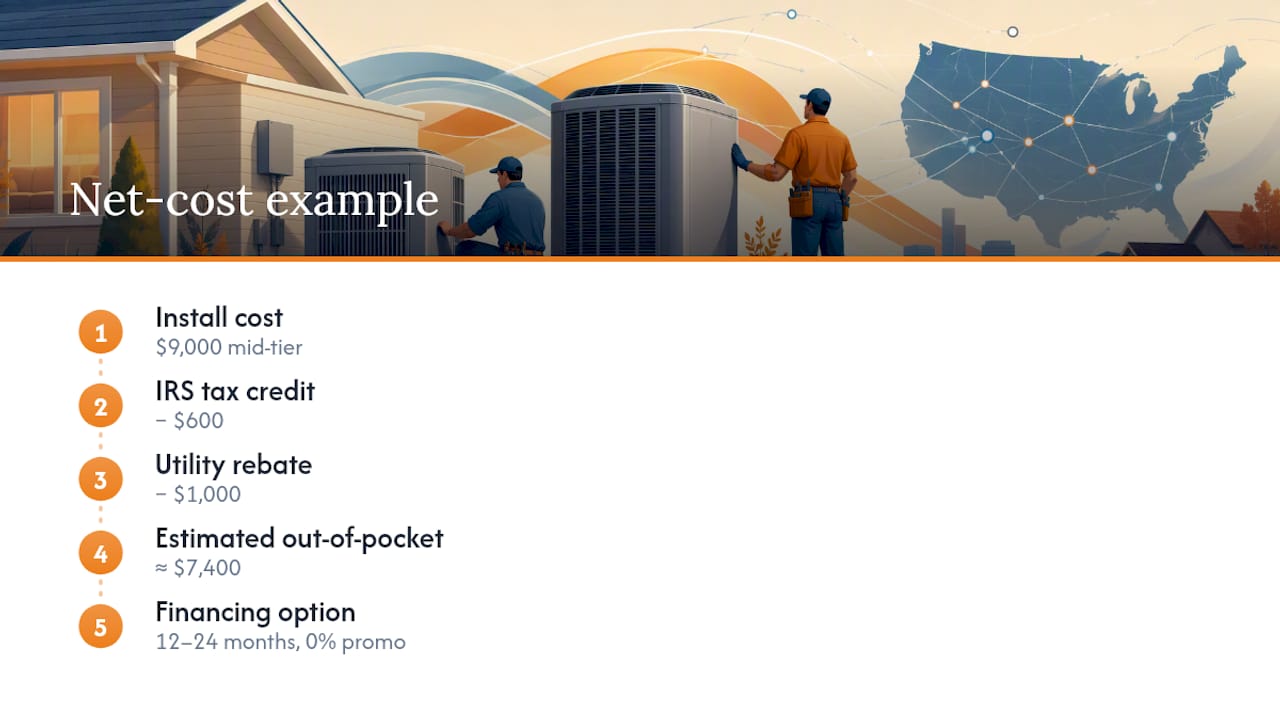
Here’s the net-cost math in practice: on a $9,000 mid-tier install that meets high-efficiency thresholds, an IRS-style tax credit worth $600 brings your effective cost down to roughly $8,400. Add a $1,000 utility rebate on top of that, and you’re closer to $7,400 out of pocket, depending on how your state treats stacked incentives. Financing through a contractor or a 0% promotional plan can also spread that remaining balance over 12 to 24 months without adding much cost, if you qualify.
What I’d prioritize before signing a contract
Most homeowners overthink the efficiency tier and underthink the ductwork. Unless you’re in an extreme climate zone or planning to stay in the home for 15 plus years, a mid-tier 16 SEER2 system is the right call. Premium tiers pay off slowly, and that money is often better spent fixing leaky ducts that undercut whatever system you install.
Before you sign, do three things: verify the contractor’s EPA 608 certification and A2L experience, get the model number, SEER2 rating, and refrigerant type written into the quote, and confirm in writing who’s pulling the permit.
— Paulo
Get Matched With Local HVAC Installers Through Pnvleads
Collecting three comparable quotes sounds simple until you’re the one calling five companies, explaining your project three times, and waiting days for callbacks. Pnvleads cuts that legwork out: post your HVAC replacement project once, and get matched with local professionals who actually work in your area and know your local permit process.

Because the A2L transition means not every contractor is equally prepared, matching with professionals who list real HVAC experience helps you surface installers who can speak specifically to refrigerant handling, permit pulling, and full line-item pricing, rather than a generic bid that leaves half your questions unanswered. You describe the project once, discuss details directly with matched professionals, and compare real quotes side by side instead of chasing down callbacks. Post your HVAC replacement project at Pnvleads and start collecting local quotes today.
Where to Verify These Numbers
Run these sources against your own ZIP code and system size before finalizing a budget:
- 2026 AC replacement cost breakdown for tier-by-tier pricing
- HVAC replacement cost calculator for a home-specific estimate
- Your state energy office or utility provider’s website for current rebate amounts in your area
Sources
- 2026 AC Replacement Costs: Find Out What to Expect
- How much does HVAC replacement cost in 2026? (By tonnage, SEER, and fuel type)
- HVAC Replacement Cost Calculator (2026) — by System Type & SEER2 | CostCandor
FAQ
What is the average HVAC replacement cost in 2026?
A mid-tier 3-ton, 16 SEER2 central AC and furnace package typically runs $8,500 to $13,500 installed. Entry-level 2-ton systems can start around $4,500, while premium 4-ton, 18+ SEER2 setups can reach $15,000.
How much does a furnace replacement cost on its own?
Furnace-only replacement costs vary by fuel type and AFUE efficiency rating, but they’re generally lower than a combined AC-and-furnace change-out since only one component is being swapped. Bundling both replacements in a single visit often reduces total labor cost compared to two separate service calls.
Why did HVAC costs go up because of the A2L refrigerant change?
The mandatory shift from R-410A to R-454B, effective January 1, 2026, added per-truck retooling costs of roughly $400 to $1,200 for contractors and about 15 to 30 extra minutes of labor per job. Some of that cost gets passed through as a small line-item fee or built into labor rates.
Does ductwork replacement add significantly to HVAC installation cost?
Yes. Duct repair typically costs $1,000 to $4,500, while full ductwork replacement can run $3,500 to $8,000, and it’s the most common source of surprise costs during installation.
How can I find local HVAC contractors to compare quotes?
Post your project details once on Pnvleads and get matched with local, vetted service professionals in your area. You discuss project specifics directly with each match, making it easier to collect the three comparable, itemized quotes needed to budget accurately.